
Scurry County Court Records After Arrest
Scurry County court records after an arrest follow a path that is different from jail custody. The Scurry County Jail records the booking, the physical hold, and the release status. The prosecutor decides what charge to file, and that filed charge becomes the court record that moves through county or district court. For misdemeanors, the official Scurry County Attorney page says the office prosecutes adults charged with misdemeanor criminal offenses, including examples such as family violence assault, driving while intoxicated, and theft. Felony prosecution is tied to the District Attorney page, which names District Attorney Ben Smith.
The arrest record, jail record, and court record may all refer to the same event, but they do not answer the same question. Custody status and booking facts belong with the jail. Current jail lookup details belong on the Scurry County jail inmate records page. Booking photos, when available through official channels, belong with Scurry County jail mugshots. Court records after a jail arrest focus on the filed charge, arraignment docket, bond order, court setting, warrant history, and disposition.
Important: A booking charge can change before or after filing. Check the jail for custody and the court clerk or docket for the filed case.
Find Scurry County Court Records
The most useful public starting point for district court matters is the official Scurry County District Court Docket page. It publishes docket documents, including criminal arraignment PDFs. That page is not a full case-search database. It is still valuable because it shows court calendar material tied to formal case movement after an arrest. If the case is a misdemeanor, the County Attorney and county court path may be involved. If it is a felony, the District Attorney and district court path are the more likely route.
The District Clerk and District Court Docket contact page lists the district court contact at 1806 25th Street, Suite 402, Snyder, TX 79549, and gives the email scurrydc@co.scurry.tx.us. The County Clerk page lists 1806 25th Street, Suite 300, Snyder, TX 79549, phone 325-573-9316, and fax 325-573-7396. Those clerk channels are the better route for file access than trying to use the jail as a court records office.
- Confirm whether the person is in custody through Scurry County Jail before treating a jail arrest as a filed court case.
- Identify the charge level. Misdemeanors usually route through the County Attorney and county court, while felony cases route through the District Attorney and district court.
- Check the District Court Docket page for published arraignment or criminal docket PDFs if the case may be in district court.
- Contact the District Clerk for district court file access, or the County Clerk and County Attorney for misdemeanor routing.
- Use the Texas DPS conviction search only after disposition when a statewide conviction-only record is the goal.
The official docket page is useful enough to document visually. The Scurry County District Court Docket page shows published court docket links rather than a commercial arrest database.
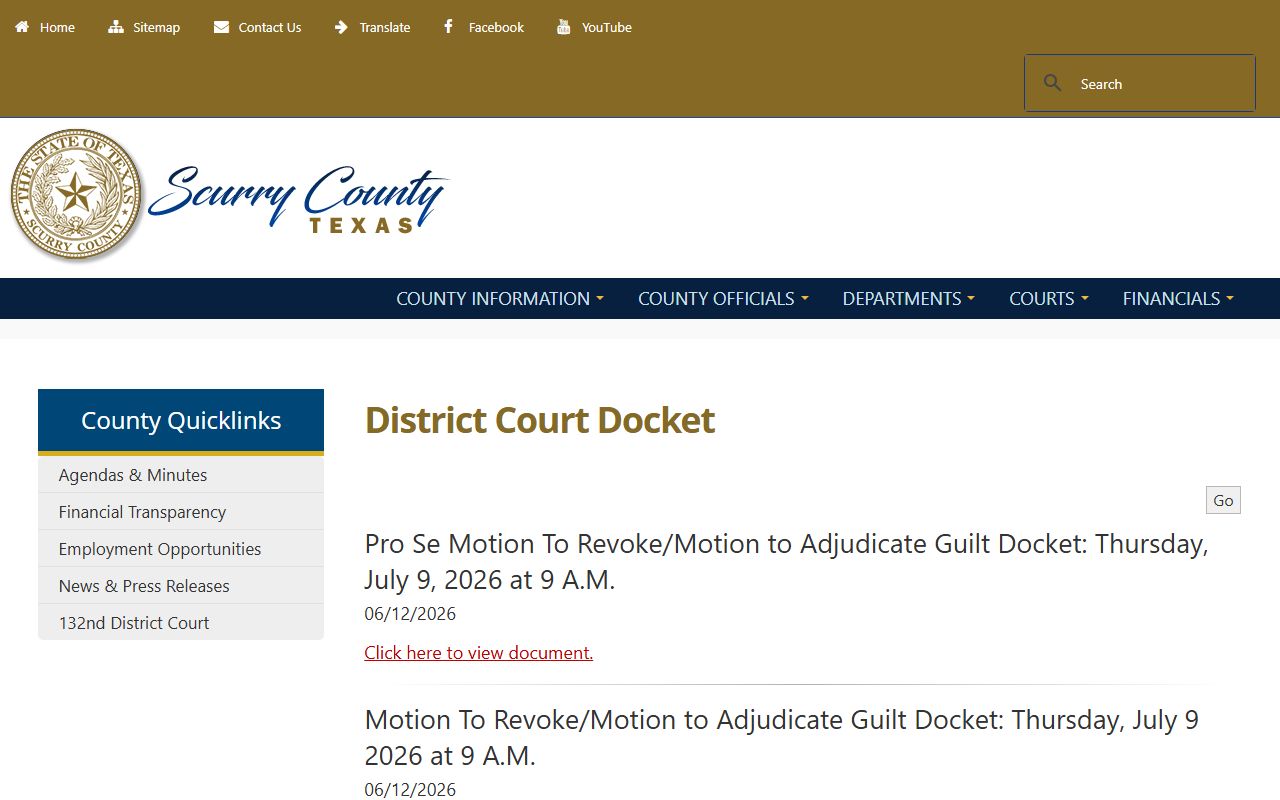
Use that docket page as a calendar and routing source, then ask the appropriate clerk for file access when the docket entry is not enough.
Scurry County Docket Search Fields
Scurry County did not provide a general criminal case-search screen in the reviewed official sources. The available court record path is a docket page with downloadable documents, plus clerk contact routes. The Texas DPS Conviction Name Search is separate. It can help with statewide conviction records, but it is not a live local docket and should not be used as proof that a new jail arrest has, or has not, been filed in Scurry County court.
| Field or Source | Type | Required | Scurry County Use |
|---|---|---|---|
| District Court Docket page | Page and document list | No | Use for official docket documents, including arraignment PDFs. |
| Arraignment PDF | PDF docket | No | Search within the PDF by defendant name or scan the calendar. |
| County Clerk land records search | Separate portal | No | Not a criminal jail-charge lookup path. |
| Texas DPS Conviction Name Search | State portal | Varies | Use for conviction-only statewide history after case disposition. |
For a new arrest, the first court record may lag behind the booking. That gap is normal. The jail may know current custody before a clerk can point to a filed case number, while a later court docket may show a charge that differs from the booking language.
Scurry County Charging Documents
Charges get filed through written instruments. A complaint may start or support a charge. An information is a prosecutor-filed charging instrument commonly used in non-indictment prosecutions. An indictment comes from a grand jury and is commonly tied to felony prosecution. In Scurry County, that matters because misdemeanor prosecution is tied to the County Attorney, while felony prosecution is tied to the District Attorney and district court system.
| Document | Who Uses It | Typical Role After Arrest | Where to Ask |
|---|---|---|---|
| Complaint | Officer, complainant, or prosecutor path | Sworn allegation or charging support for a criminal filing. | Ask the relevant court clerk or prosecutor office. |
| Information | Prosecutor | Formal prosecutor-filed charge, often for misdemeanor or non-indictment cases. | County Attorney or county court route for misdemeanors. |
| Indictment | Grand jury | Formal felony charging instrument after grand jury action. | District Clerk or District Attorney route for felonies. |
The Scurry County Attorney page is the official local source for misdemeanor prosecution details and gives the office address as 1806 25th Street, Suite 201, Snyder, TX 79549, with phone 325-573-9316.

That page helps separate misdemeanor charge routing from the jail's role in booking and custody.
Scurry County Charge Status
A charge can shift after the first jail arrest. The prosecutor may file a different charge than the arresting agency used at booking. A charge can be amended, reduced, dismissed, or resolved by plea or verdict. A court record should be read as a case record, not as a final judgment unless it clearly shows a disposition. This is especially important for Scurry County court records because the public path includes docket documents and clerk contact, not one complete online case profile.
| Status | What It Means | Scurry County Checkpoint |
|---|---|---|
| Pending | The case has not reached final disposition. | Check the docket PDF and clerk file access. |
| Amended | The filed charge changed after the first filing. | Ask the clerk for the current charging document. |
| Reduced | The charge level or offense was lowered. | Confirm with the court record, not the booking note alone. |
| Dismissed | The charge ended without a conviction on that count. | Look for a court order or docket disposition. |
| Convicted | Guilt was adjudicated by plea, verdict, or other lawful disposition. | Use the court file and, when needed, Texas DPS conviction search. |
Note: Treat a docket setting as a calendar event unless the record also shows a final order, plea, verdict, or dismissal.
Bond After Scurry County Arrest
Bond is part of the arrest-to-court path because release may be addressed near the first appearance or later court setting. Texas bail is governed by Texas Code of Criminal Procedure Chapter 17. Article 17.15 says bail should assure court appearance, should not be used as an instrument of oppression, and should account for the offense, ability to make bail, and safety of the victim and community. Scurry County's official jail page does not publish a full local bond-payment schedule, so do not assume a payment method before contacting the jail or court.
| Bond Type | Meaning | Local Caution |
|---|---|---|
| Cash bond | Money paid directly to secure release. | Confirm amount and payment method before arrival. |
| Surety bond | A licensed bail bond company guarantees the bond. | Do not rely on unofficial bond lists for current terms. |
| Personal bond or PR bond | Release based on a promise to appear, often with conditions. | Only the proper court or magistrate can confirm eligibility. |
| No-bond hold | Release is blocked until a court or agency issue is resolved. | Holds may involve warrants, parole, federal custody, or ICE. |
Scurry County jail population data includes parole violators and TDCJ-sentenced local prisoners, so not every person in jail is waiting on a simple local bond. A detainer is a hold or request from another agency. It can keep a person in custody even when a local bond issue seems resolved.
Scurry County Arrest Warrants
No official Scurry County active-warrant search page was found in the reviewed official sources. That means a person should not assume there is a public name-search warrant database for Scurry County. The practical fallback chain is the sheriff's office, the jail if the person may already be booked, the District Clerk for felony court warrants, county court or County Attorney channels for misdemeanor matters, and the Justice of the Peace courts for lower-court routing.
Texas warrant and post-arrest procedure is tied to Texas Code of Criminal Procedure Chapter 15 and Chapter 16. Those state laws do not create a Scurry County web search by themselves. A bench warrant or capias may arise from failure to appear. A parole warrant or blue warrant may involve TDCJ. An out-of-county warrant may keep a person at Scurry County Jail until another agency acts.
| Warrant Type | What It Does | Where to Start |
|---|---|---|
| Arrest warrant | Authorizes taking a person into custody. | Sheriff, jail, or issuing court. |
| Bench warrant or capias | Often follows missed court or a court-order issue. | Clerk for the court that issued it. |
| Parole warrant | May place a TDCJ parole hold on the person. | Jail, TDCJ parole route, or court record. |
| Out-of-county warrant | Another county's hold may affect release. | Jail first, then the outside agency. |
Scurry County Charges vs Convictions
An arrest and a filed charge are not a conviction. A charge is an accusation or formal filing. A conviction is a final adjudication of guilt by plea, verdict, or other qualifying disposition. This distinction is central to court records after a jail arrest because a reader may see a name on an arraignment docket and wrongly treat it as proof of guilt. The court record must be checked for the current case status and final disposition.
| Point | Charge | Conviction |
|---|---|---|
| Stage | Accusation or formal filing after arrest. | Final guilt finding or plea outcome. |
| Proof level | May begin with probable cause or prosecutor filing. | Requires a lawful conviction standard and court action. |
| Record meaning | Shows what was alleged or filed. | Shows the final criminal-history result. |
| Best source | Charging document, docket, clerk file. | Judgment, disposition, or DPS conviction search. |
For statewide conviction history, the official Texas DPS Conviction Name Search is a separate post-disposition path. It does not replace local court docket review after a new Scurry County arrest.
Sealed and Expunged Records
Texas law distinguishes restricted access from expunction. The research source for expunction is Texas Code of Criminal Procedure Chapter 55. An expunction can remove eligible arrest records from public access under a court order. Sealing or nondisclosure is a different concept and should not be described as the same result unless the actual order says so. Scurry County court, prosecutor, and jail offices should follow court orders, but no public page reviewed here promised informal removal on request.
| Point | Sealed or Restricted | Expunged |
|---|---|---|
| Public access | Hidden or limited from ordinary public view. | Treated as removed under the expunction order. |
| Agency access | Some agencies may retain limited lawful access. | Access is much more limited and order-dependent. |
| Best proof | Court nondisclosure or sealing order. | Court expunction order under Chapter 55. |
| Scurry County action | Ask the clerk or issuing court about the order. | Use the court order, not a casual deletion request. |
Restricted Scurry County Court Records
Texas public records law is broad, but it has limits. The Texas Public Information Act is Government Code Chapter 552. Law-enforcement records can be affected by exceptions, including Section 552.108 for certain active or sensitive law-enforcement material. Juvenile records, victim information, medical or mental-health details, sealed matters, and expunged records may have separate limits. A clerk or sheriff response can be narrower than a requester expects, especially when the case is active.
The sheriff's open-records process remains useful for reports, calls for service, and Scurry County jailings, but that is not the same as a court file. Court records after arrest should be requested from the court or clerk that holds the case. If the request involves both custody and filed charges, use both paths and keep the answers separate.
Scurry County Background Checks
Background checks are not the same as court record research. The sheriff's background-check form described in the research says it relates only to jailings that occurred in Scurry County. The Texas DPS conviction search is a statewide conviction path. A district court docket is a local court calendar source. Each one can be useful, but none should be stretched beyond what it was built to show.
Important: Scurry County Inmate Population is not a consumer reporting agency and must not be used for FCRA-covered screening decisions.